|
biz-niz ( VSMT ) |
living OR what
|
just coz U can doesn't mean U should |
|
|
| c.04 Virtual State Machine Technology - visit the micro-site |
|
|
Why VSMT? Complete control of real world states, events and actions. VSMT is a design methodology and real-time OS that supports a true state machine software architecture. 98% of the source code is written in ANSI C so is easily ported to virtually all 8, 16, 32 and 64-bit processors - just a few low-level target processor assembler functions are required. Compile, link - ready to GO!
| Visit the VSMT micro-site for full details.
The use of a real-time, multi-tasking executive is necessary in so much that the physical model, ie. the implementation, can be transposd from a logical description of a system according to the architectural concepts promoted by VSMT.
* VSMT saves you time and money with your product releases earlier with lower development costs.
* Reduced risks, increased product reliability and quality.
* Reduced maintenance.
* Minimal memory, hardware and processing overheads.
* Efficient interrupt handling for fastest possible system throughput.
A real-time, multi-tasking operating system must provide software designers with the mechanisms to build event driven systems whilst not compromising the need to implement logically partitioned components of software. It must aid both reuse and portability of logic, along with reduced development and maintenance costs. With a small yet rich set of features, all the tools necessary to monitor, control and command concurrent processes will be provided, based on well-known, simple and effective software mechanisms. Both design and implementation of product specific applications software may then be kept to a minimum since the focus of effort should be kept on the specification of tasks and their supporting state machines which should precisely reflect the high level sequence of events and actions involved with each operational process.
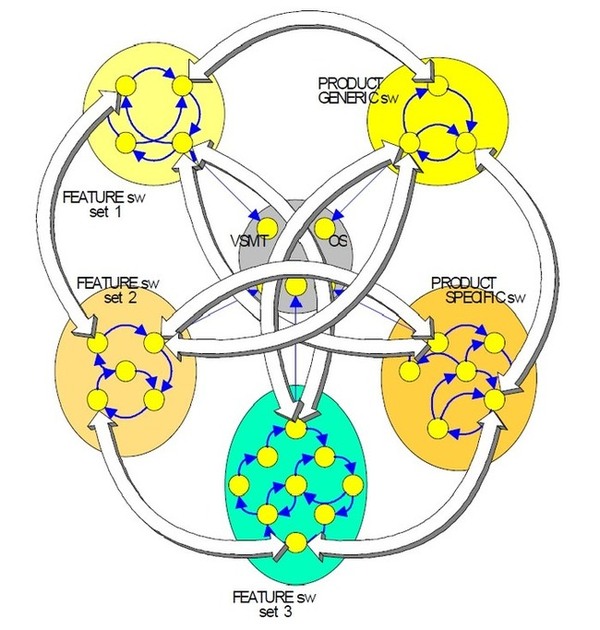
VSMT is unique since it permits each major functional process in a real-time system to be designed and coded as a separate task program that runs unlimited numbers of virtual state machines within. Tasks run concurrently like standard tasks, the difference being that the virtual states machines within become the dynamically assigned task entries in the scheduling system for the duration of a given state. State transtions correspond to changes of state machines entered in a task's scheduling list entry. | | | | | | |
|
|
 |
|
|